


Understanding the Colour Wheel & Basic Mixing Techniques
The colour wheel is a fundamental tool for artists working in any medium. Whether you’re mixing paints, planning a palette, or simply experimenting with colour, understanding how colours relate to each other can help you create more harmonious and effective artwork. This guide explains the structure and purpose of the colour wheel and provides hands-on exercises to build your confidence in mixing and using colour.
What is the Colour Wheel?
The colour wheel was first developed by Sir Isaac Newton in the 18th century to represent the relationships between colours in a circular format. It organises colours by their visual similarities and contrasts, helping artists make sense of how colours interact.
The basic structure of the colour wheel includes:
- Primary Colours: Red, blue and yellow. These cannot be created by mixing other colours and are the foundation of all others.
- Secondary Colours: Green, orange and purple, created by mixing two primary colours in equal parts.
- Tertiary Colours: Formed by mixing a primary colour with an adjacent secondary colour. Examples include red-orange and blue-green.
How Colours Relate on the Wheel
Understanding the positions of colours on the wheel is essential for choosing combinations that suit your artistic goals:
- Analogous Colours: These sit next to each other on the wheel (e.g. blue, blue-green, green) and create a sense of harmony and subtle transition.
- Complementary Colours: These are opposite each other (e.g. red and green, blue and orange) and create strong contrast, making each colour appear more vibrant when placed side by side.
Choosing between harmony and contrast allows you to control the mood and energy of your artwork.
Why the Colour Wheel Matters in Art
Using the colour wheel helps you make informed choices rather than relying on guesswork. It can support you in:
- Mixing colours more accurately
- Planning balanced and cohesive compositions
- Understanding the emotional and visual impact of colour relationships
Whether you’re painting, drawing, or designing, the colour wheel is a practical reference that simplifies colour decisions.
Practical Exercises to Build Your Skills
Theory is helpful, but real understanding comes through practice. These simple exercises are designed to help you explore colour mixing and deepen your familiarity with the colour wheel.
What You’ll Need
- Red, blue and yellow paint (primary colours)
- White paint (optional, for tints)
- Palette or mixing surface
- Paper or canvas
- A clean brush and water container
Exercise 1: Mixing Secondary Colours
- Mix red and yellow to create orange
- Mix yellow and blue to create green
- Mix blue and red to create purple
Try varying the ratios to explore different tones and intensities.
Exercise 2: Creating Tints
Add small amounts of white to each secondary colour to create lighter variations (tints). Observe how this affects the mood and softness of each colour.
Exercise 3: Complementary Contrast
Place small areas of complementary colours side by side on paper (e.g. red next to green). Notice how they seem to enhance each other’s intensity.
Exercise 4: Make Your Own Colour Wheel
Using your mixed colours, paint a 12-part colour wheel:
- Include primary, secondary, and tertiary colours
- Label each section to reinforce your understanding
Tips for Success
- Keep a sketchbook or sheet of notes to track your results
- Clean your brush thoroughly between mixes to avoid muddiness
- Be patient and work at your own pace
Summary
The colour wheel isn’t just a reference – it’s a valuable learning tool that supports more confident and expressive use of colour. By combining knowledge of colour relationships with hands-on experimentation, you’ll build a strong foundation for future creative work. With practice, you’ll begin to anticipate how colours behave and use them more effectively in your art.
Learning & Resources
-

Statement Regarding The Fire at our Bracknell Facility
As the situation develops, we will continue to update our community as the situation develops. Latest update: 02.06.2026. -

Ben Woodhams Wins Daler-Rowney Award at The Natural Eye 2026
The Society of Wildlife Artists’ 63rd Annual Exhibition, The Natural Eye 2026, celebrates the extraordinary range of artistic responses to the natural world. This year, Daler-Rowney is delighted to recognise Ben Woodhams SWLA, whose entire body of work submitted for the exhibition received the Daler-Rowney Award. -

An Doan Nguyen
An Doan Nguyen’s paintings move between photorealism and expressive abstraction, combining dramatic light, bold colour and atmospheric compositions to explore the tension between solitude, memory and the vibrancy of life. -

Studio Confessions with Jen Dixon: Creative Risks, Failed Experiments & Finding Your Voice
Behind every finished artwork are the parts we don't always see: the failed experiments, creative risks, moments of self-doubt, unexpected discoveries, and lessons learned along the way. -

Where Sea Meets Land: The Daler-Rowney Prize at the Marine Artists Society Exhibition 2026
The shoreline is never quite the same twice. Tides shift, light changes, rocks are revealed and submerged, and the surface of the water constantly alters the landscape around it. For artists, this meeting point between land and sea offers an ever-changing subject to observe and interpret. -

Women in Art Prize 2026: Celebrating Women Artists and Emerging Talent
The Women in Art Prize has announced the winners of its ninth annual awards, celebrating women artists working across painting, sculpture, photography, printmaking, digital and moving image, as well as creating opportunities for exhibition, mentoring, residencies and international artist development. -

Clarice Gomes
Clarice Gomes is a watercolour artist, author and retreat host known for her pretty, romantic and loose style, using nature-inspired painting to encourage creativity, calm and connection. -

Eva Volf
Eva Volf is a Cleveland-based fine artist known for atmospheric oil-on-canvas seascapes inspired by her travels, coastal memories and connection to the sea, with her work exhibited and collected internationally.
Frequently Asked Questions
How do you dispose of the tubes and paint?
Can the Watercolour Varnish be thinned and how should I do it?
What type of brush should I use should I use to apply varnish?
Why is the Watercolour Varnish difficult to apply?
What is the difference between lightweight and heavyweight drawing paper?
What is the difference between alla prima vs layered in oil painting?
How do you mix oil paint colours cleanly?
How do you choose the right watercolour paper?
How do you create soft and hard edges in watercolour?
How do you lift watercolour paint safely?
How do you use heavy body vs fluid acrylic?
How do you blend acrylics before they dry?
Canvas vs paper vs board: when to use each
Oil paint drying times: what to expect and why it varies
What does “fat over lean” mean when oil painting?
How do you glaze with oil paint?
How do you build layers when painting with oils?
Wet-on-wet vs wet-on-dry: when do you use each technique?
How do you layer watercolour without lifting previous paint?
How do you paint a clean watercolour wash (flat and graded)?
How do you control water for better watercolour results?
How do you glaze with acrylic for depth?
How do you layer acrylic paint cleanly?
How do you build texture with acrylics?
What paper should I use for watercolour?
Do I need solvents for oil painting?
Why is my oil painting cracking?
What’s the difference between pans and tubes?
Can I layer watercolour?
How do I stop blooms and backruns?
Why do my watercolours dry lighter than expected?
How do I stop streaks in acrylic paint?
Why do my acrylic colours look dull?
Can I use acrylic paint on any surface?
Why is my acrylic paint cracking?
How can I slow down acrylic drying time?
Why does my watercolour appear blotchy or uneven on paper?
How do I improve the water miscibility of the watermixable oils?
Why aren’t my water-mixable oil colours drying quickly enough?
Why is my watercolour paint too thick and hard to brush out?
Why are my oil colours drying too slowly?
Why are my oil colours too thick or difficult to brush out?
Why does my acrylic feel heavy or drag on the brush when painting?
Why is my acrylic paint drying too quickly?
Why does my acrylic paint dry too glossy?
How do I reduce the viscosity of the System3 Screen Printing Medium?
Why does my acrylic paint dry with a finish that is too matt?
Why is my acrylic or gesso too thick, gelatinous, or gloopy?
Do the Georgian Water Mixable Oils contain preservative Methylisothiazolinone and similar synthetic preservatives?
How do I update my preferences or subscribe to your newsletter?
How do I collaborate with/get sponsored by Daler-Rowney?
Where can I download your logo or product images/assets?
I didn’t receive any canvas wedges, where can I request them?
Do you sell other brands?
Can I buy directly from you?
Am I able to order samples?
Do you test on animals or use animal-derived ingredients?
What is the Fine Art Trade Guild?
I have scanned the QR code on the back of the Screen Printing kit product packaging but it does not lead anywhere?
I have scanned the QR code on the back of the product packaging but it does not lead anywhere?
How do I contribute a new how-to to your techniques page?
How do I find out more information about old products?
How do you preserve the longevity of finished artworks on paper?
How do I attach the canvas wedges?
How long do you need to leave an oil painting before varnishing?
I would like to try a medium, what would you advise?
How do you revive paint?
How do you open the Fluid Acrylics tubes?
To open the 250ml and 500ml Fluid Acrylic or many of our larger size paint tubes, cut along the top line as indicated in the image.

My art masking fluid is coagulation and thickening, what should I do?
What do the terms pigments and solvents mean?
What does FSC® mean?
What does hue mean?
A hue is the actual colour of something. A term often used to refer to the dominant pure colour within a colour.

How do you prepare paper and seal your artwork?
How do you prevent your drawings smudging?
How do you remove sheets from blocks?
Why is my paper buckling & how do you minimise it?
What are the available formats for artist papers?
What are archival papers?
Why are there so many shades of white for papers?
What are the variety of artist papers available and their key features?
What are the ingredients of artist papers?
What are the differences between white/natural and coloured paper for finished artworks?
What does is the difference between smooth and textured paper?
What does sizing and paper weights mean?
How are artist papers manufactured?
How do pastels stick to papers?
What technique is not supported by mixed media papers?
What are the characteristics of mixed media paper?
What techniques are best used on drawing and sketching papers?
What is the difference between the different weights of the Fine Grain paper range?
Why are acid-free papers important for artists?
Are your surfaces acid-free?
Do your products contain per-and polyfluoroalkyl substances?
What do the surface symbols mean on your paints?
The symbols represent where the paint can be used, for example, Canvas, Murals, Glass, Textiles, and Interior/Exterior. Please visit the colour charts on the individual product pages to view the full list.
You will need to use the correct primers and finishes for a selection of surfaces, i.e., murals will need a varnish to make them waterproof and a primer on most wall surfaces to get the full colour. We do always recommend trialling on a small area and testing first.

Are your products non-hazardous?
What type of palette should you use with which type of paint?
What is the difference between artists and student colours?
What do all the different mediums do?
What is the difference between all our inks?
What is the difference between the different whites in our ranges?
What is the advantage of using the products in the same collections for artists?
What do I do if my ink is seperated?
Why is the System3 collection good for murals?
How many times is the colour milled to create Georgian oils?
How do I paint on plastic using acrylic paints?
What medium would you recommend to a beginner watercolour artist to try out alongside Aquafine watercolour paints for some great effects?
What medium could you thin your oil paint down with and at the same time slow down the drying time?
What oils do you use in your oil paints?
What is drying oil?
Do your watercolour paints have granulation and staining properties?
How should I take care of my artist brushes?
What filament is best for what technique?
The filament of a brush can be suitable for more than one technique. This table indicates the prime technique for each filament type, but also provides a guide of suitability for the others.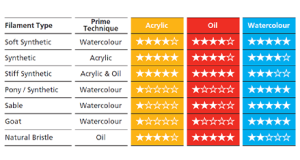
Can you explain what the different brush types do?
Would your products affect any allergies that I may have?
What does the hazardous symbol on the label mean?
The hazardous symbols are attributed to substances that are hazardous to the environment – these are standard symbols on artist paints.
The most standard symbol on art products is a dead tree and a dead fish symbol. This symbol means the product is toxic to marine life with long-lasting effects. Our recommendation when cleaning your products is to put the washings into a sand bin rather than down the sink.

Are your products EN71 compliant?
What are the shelf lives of your paints?
What’s the difference between water-based v solvent – based paints and why preservatives are used?
Do you sell a colour wheel?
Where can I download a product’s colour chart?
What levels are your products?
Where can I find your latest Safety Datasheets (SDS) or Technical Data sheets (TDS)
How should I store sketchbooks and drawings?
What is the difference between sketching pencils and coloured pencils?
Can I mix media on drawing paper?
What is the benefit of using different paper textures?
Why does my paper buckle when using wet media?
What is the best paper for beginners?
Can I erase easily on drawing paper?
What is the difference between sketchbooks in the range?
What drawing materials work best on Daler-Rowney sketchbooks?
Can I use watercolour on drawing paper?
What is the difference between smooth and textured drawing paper?
What is cartridge paper used for?
Can I use ink or markers on drawing paper?
What is “tooth” in drawing paper?
What is the difference between sketch paper and drawing paper?
What can I use drawing and sketching paper for?

Find a Store Near You
Our products are available in thousands stores nationwide. Use our Store Locator to find your nearest retailer and explore our network of trusted art supply specialists. Visit in person to experience the quality firsthand, receive expert advice, and shop your favourite Daler-Rowney products locally.

Contact Us
Got a question? Start by browsing our FAQs for quick answers. If you can’t find what you’re looking for, get in touch by selecting the form that best matches your enquiry. We’d love to hear from you and are always happy to assist!


