


The Science of Paper and How to Match It to Your Medium
At first glance, paper may seem like a simple support for art, but its composition and surface qualities have a profound impact on how your materials perform. Whether you’re sketching, painting, or printing, understanding the science behind paper and how it interacts with different media is essential for achieving the best results and avoiding common frustrations.
Fibres: The Foundation of Paper Performance
The fibres that make up paper largely determine its absorbency, strength, and longevity. The two most common types of fibres used are wood pulp and cotton (or rag).
- Wood pulp paper is the most common, affordable, and versatile. Perfect for dry techniques, heavier weights are also suitable for watercolour and other wet techniques
- Cotton (rag) paper is prized for its superior strength, even absorbency, and excellent durability with wet techniques. It resists breakdown under repeated washes, making it ideal for watercolour.
Manufacturing Methods: Mould-Made vs. Machine-Made
Paper can be produced by different methods, which influence the texture and durability of the final product. Mould-made paper is crafted to mimic the characteristics of traditional handmade sheets. This process results in a random fibre distribution and a naturally varied surface texture, complete with stronger, more defined edges. Such paper is often favoured by professionals because it offers enhanced strength and a pleasing tactile quality. In contrast, machine-made paper is manufactured quickly and in large volumes. Its fibres tend to be more uniformly aligned and compressed, producing a smoother, more consistent surface that is less expensive but generally less durable. For artists prioritising longevity and texture, mould-made papers tend to be the better investment.
- Mould-made paper simulates traditional handmade techniques, resulting in a more random fibre distribution, natural surface texture, and stronger edges. This makes it highly durable and is favoured by professional watercolourists.
- Machine-made paper is produced faster and more economically, with a more uniform and compressed fibre structure. Excellent for a wide variety of drawing and sketching techniques and wet techniques in higher weights.
Sizing: Controlling Absorbency
Sizing is a critical, often overlooked aspect of paper that controls how much water or pigment the surface absorbs. There are two main types: internal and surface sizing. Internal sizing is incorporated during the paper manufacturing process and affects the entire sheet, making it less absorbent and helping to keep washes vibrant. Surface sizing, applied after the paper is formed, modifies how media behave directly on the surface. A well-sized paper provides a balance that prevents pigment from soaking in too deeply, which can dull colours, or conversely, from pooling excessively on the surface. This balance is particularly important for watercolour artists, who rely on sizing to maintain control over washes and gradients. Papers with too little sizing can feel blotchy and uncontrolled, while those with excessive sizing may cause colours to slip or pool.
- Internal sizing is added during manufacturing and affects the entire sheet, helping to maintain brightness and prevent excessive absorbency.
- Surface sizing is applied after the paper is formed and adjusts how media behave on the surface.
Too much sizing can cause pigment to pool or slip, while too little leads to dull, blotchy washes. Watercolour artists especially need a balanced sizing level for flow control.
Understanding Paper Specifications
When choosing paper, understanding the terminology and specifications can save you from costly mistakes. The weight of the paper is measured in grams per square metre (GSM). Heavier papers, usually above 250gsm, tend to handle wet media better, resisting warping and buckling. The texture of the paper is also important: hot-pressed papers have a very smooth finish, cold-pressed (also known as NOT) papers offer a medium texture with slight tooth, and rough papers provide a pronounced texture. Additionally, for artworks meant to last, selecting acid-free or pH-neutral papers is essential, as they resist yellowing and degradation over time. Trusted suppliers will provide detail on the specifications and learning to interpret these will help you match paper to your artistic needs precisely.
- GSM (grams per square metre): Heavier papers (250gsm and above) are more durable and will handle wet techniques better, resisting buckling.
- Texture: The textures of Rough and Cold Pressed Watercolour paper textures tend to more pronounced, Hot Pressed being smooth. Drawing and sketching papers can also be textured or smooth.
- Archival qualities: Look for acid-free or pH-neutral labels for longevity. Look for a mention of acid-free on a pad cover before purchasing.
Matching Paper to Medium and Technique
Each medium interacts differently with paper surfaces, and selecting the right combination enhances the quality of your work. Graphite pencils, for instance, benefit from smooth surfaces that allow precise lines and reduce smudging. Pastels, in contrast, need a toothy paper that can grip the powdery pigment, allowing rich layering and blending. Ink demands careful consideration of absorbency; insufficient sizing can cause ink to bleed and feather, spoiling fine details.
For watercolour and other wet techniques, Hot-pressed papers are often recommended for detailed work due to their smoothness. Any texture of a paper used for watercolour will be visible when the artwork is complete, so choose a Cold-pressed or Rough paper depending how much texture is preferred in the finished work. Drawing and sketching papers are also available in a variety of textures, with smoother surfaces being ideal for detail work and others featuring a tooth suited to pastel or charcoal work for example.
- Graphite thrives on smooth surfaces for crisp lines and minimal smudging.
- Pastel demands a toothy texture to grip pigment well.
- Ink requires well-sized paper to prevent bleeding; too absorbent paper causes spreading.
- Hot-pressed paper is very smooth, ideal for fine detail.
- Cold-pressed (NOT) paper offers a balanced texture, the most popular texture with watercolourists.
- Rough paper the most pronounced watercolour texture.
Specialty and Mixed Media Papers
For artists working with mixed media or specialised materials, there are papers designed to accommodate the unique demands of each. Mixed media papers are formulated to accept both wet and dry techniques, making them excellent for experimentation, travel sketchbooks, or students learning multiple methods.
Gouache, with its opaque qualities, performs best on heavier watercolour paper that retains some tooth to help the pigment adhere evenly. Acrylic paints require papers that are not only heavy but also strong and often internally sized to withstand repeated wet layers without deteriorating. Oil painting on paper requires specially treated oil paper that includes a barrier layer to protect the surface from oil absorption, which otherwise causes the paper to weaken and degrade.
- Mixed media paper balances wet and dry media requirements, making it a versatile choice for experimentation, students, and travel sketchbooks.
- Gouache works well on heavy watercolour paper with some tooth for better pigment hold.
- Acrylic paper is heavier and stronger, often internally sized for durability with acrylics.
- Oil paper has a barrier layer to prevent oil absorption, protecting the paper from deterioration; standard paper is unsuitable for oils.
Summary
Featured Papers

Georgian Oil Paper
System3 Acrylic Artboard

Aquafine Watercolour Artbook

Fine Grain Drawing Paper
-
Papers For Painting
Georgian Oil Paper
The Georgian Oil Paper Pad contains acid-free, natural white sheets of linen-textured oil painting paper, each 290gsm and FSC® certified (FSC-C111372). The embossed surface offers a texture closely resembling linen canvas, providing excellent support for oil paints. Also available as in 1.4mm Artboard. This stiff and substantial paper absorbs oil evenly, preserving the brightness, intensity […]LEARN MORE -
Papers For Painting
System3 Acrylic Artboard
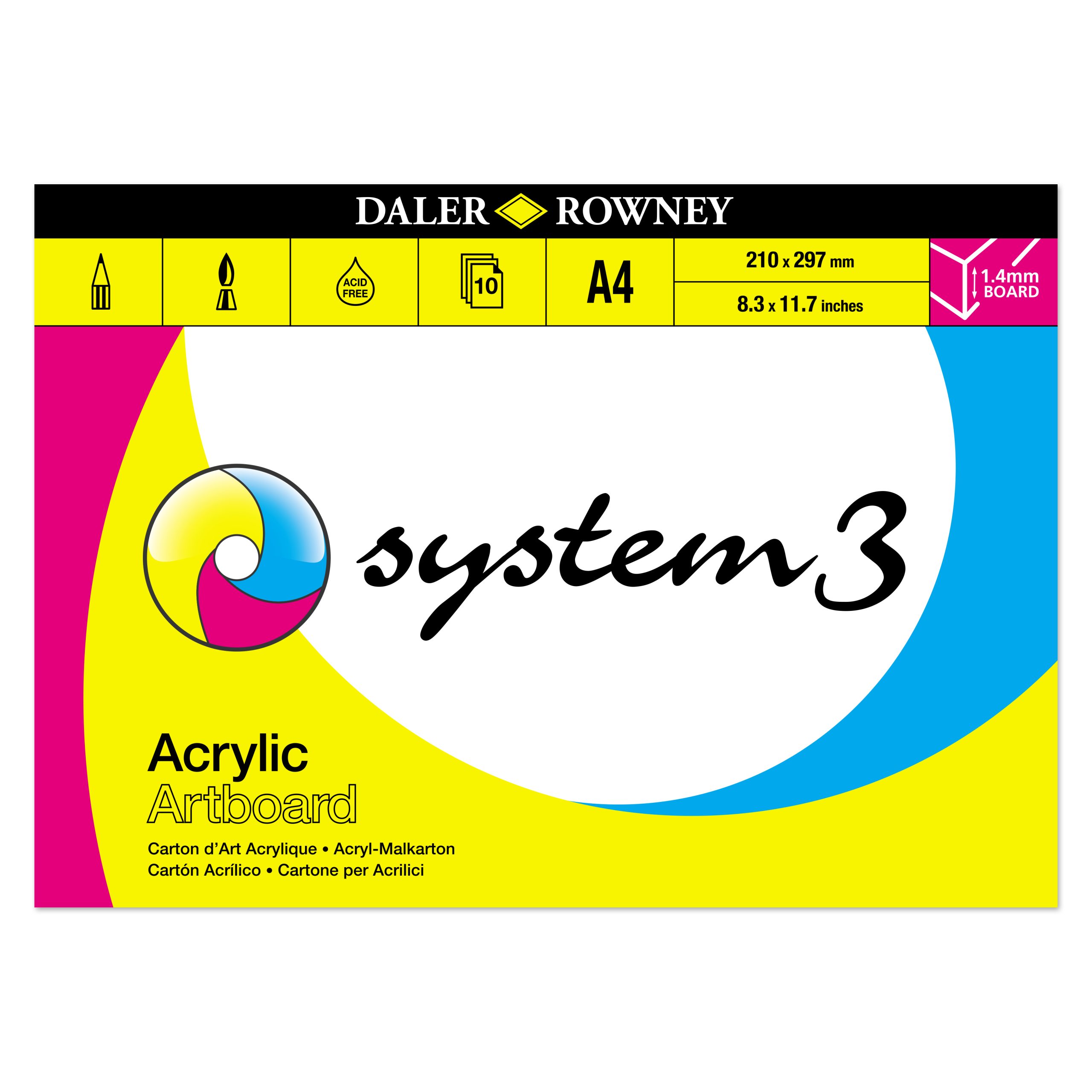
System3 Artboard is the perfect surface for acrylic paints, inks, and mediums – designed for artists who value quality and convenience. Each artboard features textured System3 acrylic paper, expertly laminated onto a 1.4mm rigid board. This ready-to-use surface offers the freedom to create anywhere, with a sturdy backing that supports work on the go. The […]LEARN MORE -
Papers For Painting
Aquafine Watercolour Artbook
Aquafine Texture Watercolour Artbook features acid-free, cold-pressed 300gsm watercolour paper certified by FSC® (FSC-C111372), ensuring responsible sourcing. The A5 size and spiral binding create a convenient travel-sized format, perfect for watercolourists who favour a lightly textured surface to enhance their work whilst on the go. The natural white sheets offer excellent water absorbency and a […]LEARN MORE -
Papers For Dry Techniques
Fine Grain Drawing Paper
The Fine Grain Drawing pad contains sheets of crisp white 120gsm paper, certified FSC® (FSC-C111372) for responsible sourcing. Its lightly textured surface is perfect for dry media such as pencils, charcoal, and pen and ink. The lighter weight makes it ideal for high-quality drafts and sketches. Each sheet is acid free, internally sized with synthetic […]LEARN MORE
Learning & Resources
-
Paper Lab
The Science of Paper and How to Match It to Your Medium
Discover how mixed media artist Lara Blake uses vibrant ink and fluid acrylics to express emotion through movement. -
 Paper Lab
Developing Skills with the Right Paper: Tips for Art Students
Discover how mixed media artist Lara Blake uses vibrant ink and fluid acrylics to express emotion through movement. -
 Paper Lab
Understanding Fine Art Paper: What You Need to Know
Discover how mixed media artist Lara Blake uses vibrant ink and fluid acrylics to express emotion through movement. -
 Brush LabColour Lab
How To Get Started with Watercolours & Materials with Oliver Pyle
Oliver Pyle, a renowned British landscape artist, explains how to get started with watercolour and what materials you should be using.
Frequently Asked Questions
How do you dispose of the tubes and paint?
Can the Watercolour Varnish be thinned and how should I do it?
What type of brush should I use should I use to apply varnish?
Why is the Watercolour Varnish difficult to apply?
What is the difference between lightweight and heavyweight drawing paper?
What is the difference between alla prima vs layered in oil painting?
How do you mix oil paint colours cleanly?
How do you choose the right watercolour paper?
How do you create soft and hard edges in watercolour?
How do you lift watercolour paint safely?
How do you use heavy body vs fluid acrylic?
How do you blend acrylics before they dry?
Canvas vs paper vs board: when to use each
Oil paint drying times: what to expect and why it varies
What does “fat over lean” mean when oil painting?
How do you glaze with oil paint?
How do you build layers when painting with oils?
Wet-on-wet vs wet-on-dry: when do you use each technique?
How do you layer watercolour without lifting previous paint?
How do you paint a clean watercolour wash (flat and graded)?
How do you control water for better watercolour results?
How do you glaze with acrylic for depth?
How do you layer acrylic paint cleanly?
How do you build texture with acrylics?
What paper should I use for watercolour?
Do I need solvents for oil painting?
Why is my oil painting cracking?
What’s the difference between pans and tubes?
Can I layer watercolour?
How do I stop blooms and backruns?
Why do my watercolours dry lighter than expected?
How do I stop streaks in acrylic paint?
Why do my acrylic colours look dull?
Can I use acrylic paint on any surface?
Why is my acrylic paint cracking?
How can I slow down acrylic drying time?
Why does my watercolour appear blotchy or uneven on paper?
How do I improve the water miscibility of the watermixable oils?
Why aren’t my water-mixable oil colours drying quickly enough?
Why is my watercolour paint too thick and hard to brush out?
Why are my oil colours drying too slowly?
Why are my oil colours too thick or difficult to brush out?
Why does my acrylic feel heavy or drag on the brush when painting?
Why is my acrylic paint drying too quickly?
Why does my acrylic paint dry too glossy?
How do I reduce the viscosity of the System3 Screen Printing Medium?
Why does my acrylic paint dry with a finish that is too matt?
Why is my acrylic or gesso too thick, gelatinous, or gloopy?
Do the Georgian Water Mixable Oils contain preservative Methylisothiazolinone and similar synthetic preservatives?
How do I update my preferences or subscribe to your newsletter?
How do I collaborate with/get sponsored by Daler-Rowney?
Where can I download your logo or product images/assets?
I didn’t receive any canvas wedges, where can I request them?
Do you sell other brands?
Can I buy directly from you?
Am I able to order samples?
Do you test on animals or use animal-derived ingredients?
What is the Fine Art Trade Guild?
I have scanned the QR code on the back of the Screen Printing kit product packaging but it does not lead anywhere?
I have scanned the QR code on the back of the product packaging but it does not lead anywhere?
How do I contribute a new how-to to your techniques page?
How do I find out more information about old products?
How do you preserve the longevity of finished artworks on paper?
How do I attach the canvas wedges?
How long do you need to leave an oil painting before varnishing?
I would like to try a medium, what would you advise?
How do you revive paint?
How do you open the Fluid Acrylics tubes?
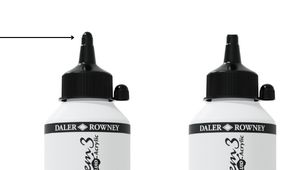
To open the 250ml and 500ml Fluid Acrylic or many of our larger size paint tubes, cut along the top line as indicated in the image.
My art masking fluid is coagulation and thickening, what should I do?
What do the terms pigments and solvents mean?
What does FSC® mean?
What does hue mean?
A hue is the actual colour of something. A term often used to refer to the dominant pure colour within a colour.
How do you prepare paper and seal your artwork?
How do you prevent your drawings smudging?
How do you remove sheets from blocks?
Why is my paper buckling & how do you minimise it?
What are the available formats for artist papers?
What are archival papers?
Why are there so many shades of white for papers?
What are the variety of artist papers available and their key features?
What are the ingredients of artist papers?
What are the differences between white/natural and coloured paper for finished artworks?
What does is the difference between smooth and textured paper?
What does sizing and paper weights mean?
How are artist papers manufactured?
How do pastels stick to papers?
What technique is not supported by mixed media papers?
What are the characteristics of mixed media paper?
What techniques are best used on drawing and sketching papers?
What is the difference between the different weights of the Fine Grain paper range?
Why are acid-free papers important for artists?
Are your surfaces acid-free?
Do your products contain per-and polyfluoroalkyl substances?
What do the surface symbols mean on your paints?
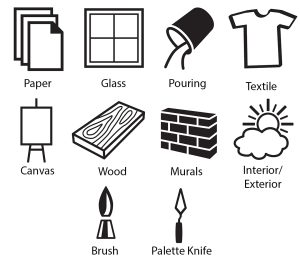
The symbols represent where the paint can be used, for example, Canvas, Murals, Glass, Textiles, and Interior/Exterior. Please visit the colour charts on the individual product pages to view the full list.
You will need to use the correct primers and finishes for a selection of surfaces, i.e., murals will need a varnish to make them waterproof and a primer on most wall surfaces to get the full colour. We do always recommend trialling on a small area and testing first.
Are your products non-hazardous?
What type of palette should you use with which type of paint?
What is the difference between artists and student colours?
What do all the different mediums do?
What is the difference between all our inks?
What is the difference between the different whites in our ranges?
What is the advantage of using the products in the same collections for artists?
What do I do if my ink is seperated?
Why is the System3 collection good for murals?
How many times is the colour milled to create Georgian oils?
How do I paint on plastic using acrylic paints?
What medium would you recommend to a beginner watercolour artist to try out alongside Aquafine watercolour paints for some great effects?
What medium could you thin your oil paint down with and at the same time slow down the drying time?
What oils do you use in your oil paints?
What is drying oil?
Do your watercolour paints have granulation and staining properties?
How should I take care of my artist brushes?
What filament is best for what technique?
The filament of a brush can be suitable for more than one technique. This table indicates the prime technique for each filament type, but also provides a guide of suitability for the others.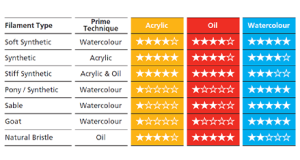
Can you explain what the different brush types do?
Would your products affect any allergies that I may have?
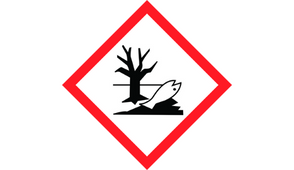
What does the hazardous symbol on the label mean?
The hazardous symbols are attributed to substances that are hazardous to the environment – these are standard symbols on artist paints.
The most standard symbol on art products is a dead tree and a dead fish symbol. This symbol means the product is toxic to marine life with long-lasting effects. Our recommendation when cleaning your products is to put the washings into a sand bin rather than down the sink.
Are your products EN71 compliant?
What are the shelf lives of your paints?
What’s the difference between water-based v solvent – based paints and why preservatives are used?
Do you sell a colour wheel?
Where can I download a product’s colour chart?
What levels are your products?
Where can I find your latest Safety Datasheets (SDS) or Technical Data sheets (TDS)
How should I store sketchbooks and drawings?
What is the difference between sketching pencils and coloured pencils?
Can I mix media on drawing paper?
What is the benefit of using different paper textures?
Why does my paper buckle when using wet media?
What is the best paper for beginners?
Can I erase easily on drawing paper?
What is the difference between sketchbooks in the range?
What drawing materials work best on Daler-Rowney sketchbooks?
Can I use watercolour on drawing paper?
What is the difference between smooth and textured drawing paper?
What is cartridge paper used for?
Can I use ink or markers on drawing paper?
What is “tooth” in drawing paper?
What is the difference between sketch paper and drawing paper?
What can I use drawing and sketching paper for?

Find a Store Near You
Our products are available in thousands stores nationwide. Use our Store Locator to find your nearest retailer and explore our network of trusted art supply specialists. Visit in person to experience the quality firsthand, receive expert advice, and shop your favourite Daler-Rowney products locally.

Contact Us
Got a question? Start by browsing our FAQs for quick answers. If you can’t find what you’re looking for, get in touch by selecting the form that best matches your enquiry. We’d love to hear from you and are always happy to assist!


