


Ebony
Sketchbooks have been a constant and essential companion for artists throughout the years. Like many prominent artists before him, John Howe uses Ebony as a medium for his amazing talent on his many travels around the globe. His pieces of art for The Lord of the Rings and The Hobbit have come alive on the pages of an Ebony sketchbook. In his own words: “They are quite simply the best sketchbooks I have ever owned”.
What are Ebony Sketchbooks?
Ebony sketchbooks have long been a trusted companion for artists, providing a reliable canvas for creativity on the move. Celebrated illustrator John Howe, known for his work on The Lord of the Rings and The Hobbit, favours Ebony sketchbooks for their quality and versatility, calling them “quite simply the best sketchbooks I have ever owned.” Designed to meet professional standards, the Ebony collection features hardback sketchbooks with 160gsm cartridge paper in natural white, extra white, or black, offering a surface suitable for pencil, charcoal, pen, ink, light watercolour, and mixed media.
The Ebony range combines durability with practicality, offering both hardback and spiral-bound options, the latter allowing the book to lie flat for ease of use. Available in sizes from A6 to A3 and in portrait, landscape, or square formats, Ebony sketchbooks accommodate both intricate detail and expansive sketches. The Extra White versions, in particular, provide a lightly textured surface ideal for graphite, coloured pencils, charcoal, and ink, giving artists a premium-quality medium for a wide variety of techniques and styles.
Features of Ebony sketchbooks
-


Hardbound, wirebound and stapled sketchbooks
Providing strong, flexible options to fit every artist’s way of working, from hardbound for durability to wirebound for easy page turning and stapled for lightweight portability.
-


White and black paper options
Features three acid-free paper options – white, extra white, and black – with a neutral pH to help prevent fading and discolouration, keeping your work looking fresh and permanent over time.
-

Suitable for dry techniques
The smooth, natural white cartridge paper enhances pencil, pen and ink and light watercolour wash work.
-

Wide range of sizes
Ebony sketchbooks come in all the sizes an artist might need, including A6, A5, A4 and A3, in both landscape and portrait formats.
Creating with the Ebony Collection
-
 Paper Lab
The Science of Paper and How to Match It to Your Medium
Discover how mixed media artist Lara Blake uses vibrant ink and fluid acrylics to express emotion through movement. -
 Paper Lab
Developing Skills with the Right Paper: Tips for Art Students
Discover how mixed media artist Lara Blake uses vibrant ink and fluid acrylics to express emotion through movement. -
 Paper Lab
Understanding Fine Art Paper: What You Need to Know
Discover how mixed media artist Lara Blake uses vibrant ink and fluid acrylics to express emotion through movement. -
 Brush LabColour Lab
How To Get Started with Watercolours & Materials with Oliver Pyle
Oliver Pyle, a renowned British landscape artist, explains how to get started with watercolour and what materials you should be using.
Start sketching with Ebony
Begin your visual and artistic journey with the stylish Ebony sketchbooks. Explore the whole collection of hardback and spiral sketchbooks here and share your work with #EbonySketchbook.

Ebony Black Sketchbooks

Ebony Extra White Sketchbooks

Ebony Sketchbooks
Frequently Asked Questions
How do you dispose of the tubes and paint?
Can the Watercolour Varnish be thinned and how should I do it?
What type of brush should I use should I use to apply varnish?
Why is the Watercolour Varnish difficult to apply?
What is the difference between lightweight and heavyweight drawing paper?
How do you choose the right watercolour paper?
How do you create soft and hard edges in watercolour?
How do you lift watercolour paint safely?
How do you use heavy body vs fluid acrylic?
How do you blend acrylics before they dry?
Canvas vs paper vs board: when to use each
How do you glaze with oil paint?
Wet-on-wet vs wet-on-dry: when do you use each technique?
How do you layer watercolour without lifting previous paint?
How do you paint a clean watercolour wash (flat and graded)?
How do you control water for better watercolour results?
How do you glaze with acrylic for depth?
How do you layer acrylic paint cleanly?
How do you build texture with acrylics?
What paper should I use for watercolour?
Do I need solvents for oil painting?
What’s the difference between pans and tubes?
Can I layer watercolour?
How do I stop blooms and backruns?
Why do my watercolours dry lighter than expected?
How do I stop streaks in acrylic paint?
Why do my acrylic colours look dull?
Can I use acrylic paint on any surface?
Why is my acrylic paint cracking?
How can I slow down acrylic drying time?
Why does my watercolour appear blotchy or uneven on paper?
How do I improve the water miscibility of the watermixable oils?
Why aren’t my water-mixable oil colours drying quickly enough?
Why is my watercolour paint too thick and hard to brush out?
Why are my oil colours drying too slowly?
Why are my oil colours too thick or difficult to brush out?
Why does my acrylic feel heavy or drag on the brush when painting?
Why is my acrylic paint drying too quickly?
Why does my acrylic paint dry too glossy?
How do I reduce the viscosity of the System3 Screen Printing Medium?
Why does my acrylic paint dry with a finish that is too matt?
Why is my acrylic or gesso too thick, gelatinous, or gloopy?
Am I able to order samples?
Do you test on animals or use animal-derived ingredients?
What is the Fine Art Trade Guild?
I have scanned the QR code on the back of the Screen Printing kit product packaging but it does not lead anywhere?
I have scanned the QR code on the back of the product packaging but it does not lead anywhere?
How do I find out more information about old products?
How do you preserve the longevity of finished artworks on paper?
How long do you need to leave an oil painting before varnishing?
I would like to try a medium, what would you advise?
How do you revive paint?
How do you open the Fluid Acrylics tubes?
To open the 250ml and 500ml Fluid Acrylic or many of our larger size paint tubes, cut along the top line as indicated in the image.

My art masking fluid is coagulation and thickening, what should I do?
What do the terms pigments and solvents mean?
What does FSC® mean?
What does hue mean?
A hue is the actual colour of something. A term often used to refer to the dominant pure colour within a colour.

How do you prepare paper and seal your artwork?
How do you prevent your drawings smudging?
How do you remove sheets from blocks?
Why is my paper buckling & how do you minimise it?
What are the available formats for artist papers?
What are archival papers?
Why are there so many shades of white for papers?
What are the variety of artist papers available and their key features?
What are the ingredients of artist papers?
What are the differences between white/natural and coloured paper for finished artworks?
What does is the difference between smooth and textured paper?
What does sizing and paper weights mean?
How are artist papers manufactured?
How do pastels stick to papers?
What technique is not supported by mixed media papers?
What are the characteristics of mixed media paper?
What techniques are best used on drawing and sketching papers?
What is the difference between the different weights of the Fine Grain paper range?
Why are acid-free papers important for artists?
Are your surfaces acid-free?
Do your products contain per-and polyfluoroalkyl substances?
What do the surface symbols mean on your paints?
The symbols represent where the paint can be used, for example, Canvas, Murals, Glass, Textiles, and Interior/Exterior. Please visit the colour charts on the individual product pages to view the full list.
You will need to use the correct primers and finishes for a selection of surfaces, i.e., murals will need a varnish to make them waterproof and a primer on most wall surfaces to get the full colour. We do always recommend trialling on a small area and testing first.

Are your products non-hazardous?
What type of palette should you use with which type of paint?
What is the difference between artists and student colours?
What do all the different mediums do?
What is the difference between all our inks?
What is the difference between the different whites in our ranges?
What is the advantage of using the products in the same collections for artists?
What do I do if my ink is seperated?
Why is the System3 collection good for murals?
How do I paint on plastic using acrylic paints?
What medium would you recommend to a beginner watercolour artist to try out alongside Aquafine watercolour paints for some great effects?
What medium could you thin your oil paint down with and at the same time slow down the drying time?
What is drying oil?
Do your watercolour paints have granulation and staining properties?
How should I take care of my artist brushes?
What filament is best for what technique?
The filament of a brush can be suitable for more than one technique. This table indicates the prime technique for each filament type, but also provides a guide of suitability for the others.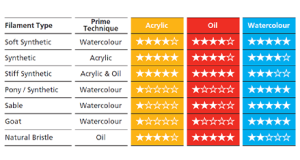
Can you explain what the different brush types do?
Would your products affect any allergies that I may have?
What does the hazardous symbol on the label mean?
The hazardous symbols are attributed to substances that are hazardous to the environment – these are standard symbols on artist paints.
The most standard symbol on art products is a dead tree and a dead fish symbol. This symbol means the product is toxic to marine life with long-lasting effects. Our recommendation when cleaning your products is to put the washings into a sand bin rather than down the sink.

Are your products EN71 compliant?
What are the shelf lives of your paints?
What’s the difference between water-based v solvent – based paints and why preservatives are used?
Where can I download a product’s colour chart?
What levels are your products?
Where can I find your latest Safety Datasheets (SDS) or Technical Data sheets (TDS)
How should I store sketchbooks and drawings?
What is the benefit of using different paper textures?
Can I mix media on drawing paper?
What is the best paper for beginners?
Why does my paper buckle when using wet media?
What is the difference between sketchbooks in the range?
Can I erase easily on drawing paper?
Can I use watercolour on drawing paper?
What drawing materials work best on Daler-Rowney sketchbooks?
What is cartridge paper used for?
What is the difference between smooth and textured drawing paper?
Can I use ink or markers on drawing paper?
What is the difference between sketch paper and drawing paper?
What is “tooth” in drawing paper?
What can I use drawing and sketching paper for?

Find a Store Near You
Our products are available in thousands stores nationwide. Use our Store Locator to find your nearest retailer and explore our network of trusted art supply specialists. Visit in person to experience the quality firsthand, receive expert advice, and shop your favourite Daler-Rowney products locally.

Contact Us
Got a question? Start by browsing our FAQs for quick answers. If you can’t find what you’re looking for, get in touch by selecting the form that best matches your enquiry. We’d love to hear from you and are always happy to assist!


